Mobile Square Silo With Discharge Valve for Pharmaceutical Raw Material Sealed Transfer & Quantitative Discharging
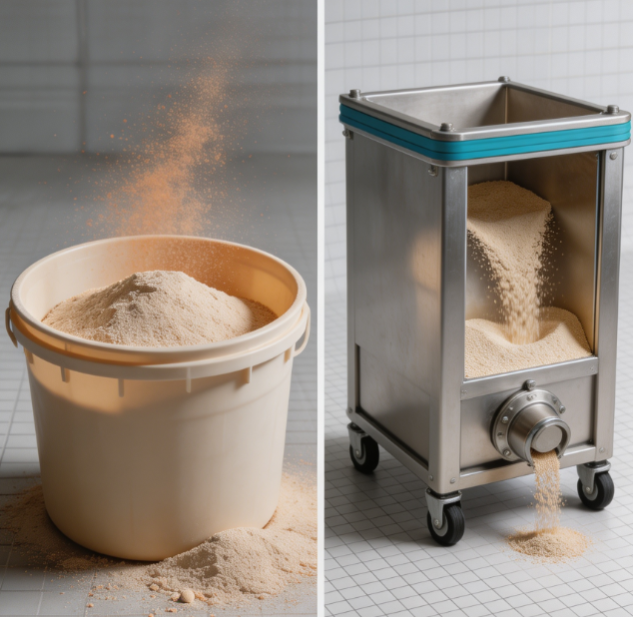
Table of Contents
1. Industry Pain Points of Traditional Pharmaceutical Powder Transfer Equipment
2. Core Structural Design of Mobile Square Silo for Pharma Raw Materials 2.1 GMP-Compliant Square Silo Main Body & Mobile Chassis 2.2 Sealed Discharge Valve Core Configuration for Quantitative Dosing 2.3 Full-Airtight Sealing System for Zero Dust Leakage Transfer
3. Authoritative Performance Parameter Comparison Table (Mobile Square Silo vs Ordinary Round Transfer Barrel)
4. Two Core Functional Advantages: Sealed Material Transfer & Precise Quantitative Discharging 4.1 Airtight Closed Transfer Cut Cross-Contamination & Operator Exposure Risks 4.2 Adjustable Discharge Valve Realize Stable Quantitative Discharging For Pharma Batch Production
5. Standard Application Scenarios in Pharmaceutical Production Lines
6. Common Production Losses Brought by Non-Sealed, Non-Quantitative Transfer Tools
7. Professional Industry FAQ
1. Industry Pain Points of Traditional Pharmaceutical Powder Transfer Equipment
Pharmaceutical API, excipient and intermediate powder transfer has super strict GMP, FDA and ISPE hygiene requirements. Most factories still adopt ordinary open round barrels or simple open hoppers for raw material turnover, this bring multiple uncontrollable quality risks. First, open transfer generates floating dust, causing cross-contamination between different batches of raw materials, industry data shows 36% of pharmaceutical batch disqualification traces back to material cross-pollution during turnover. Second, fine pharmaceutical powder easily leak out and expose operators to high-potency APIs, failing OEB occupational exposure control standards. Third, manual scooping discharge cannot control material weight accurately, leading to formula deviation and high raw material waste rate up to 12.7% in medium-sized pharma workshops. Core SEO keywords covered: mobile square silo, pharmaceutical raw material sealed transfer, quantitative discharge valve, GMP mobile powder bin, airtight pharmaceutical silo, pharma API transfer container, stainless steel mobile silo with dosing valve.
2. Core Structural Design of Mobile Square Silo for Pharma Raw Materials
2.1 GMP-Compliant Square Silo Main Body & Mobile Chassis
The silo main body adopts square upper bin + tapered cone bottom integrated structure, made of SS304 or SS316L stainless steel that meets FDA food contact standard. Inner wall is mirror polished to Ra ≤0.8μm, no cleaning dead angle, compatible with CIP online washing system for regular sterilization. Square shape improves workshop space utilization rate by 22% compared with same-volume round silos, can closely arrange multiple silos side by side without idle gaps. The mobile chassis equips four silent PU anti-static casters, two casters with foot brake lock to fix position during feeding and storage. Static grounding clips are standard to eliminate static spark risk of combustible pharmaceutical powder. Available customized volume range: 50L – 2000L, matching small lab trial batches and mass commercial production batches.
2.2 Sealed Discharge Valve Core Configuration for Quantitative Dosing
The bottom matched discharge valve is customized for pharmaceutical powder fluidity, two mainstream optional types: stainless steel rotary star valve and sealed butterfly dosing valve. Valve internal lining uses food-grade silicone sealing gasket with FDA certification, no powder residue adhesion on valve cavity surface after long-term operation. It supports manual adjusting discharge opening stroke or PLC automatic frequency control, linking with load cell weighing module to realize real-time quantitative discharging feedback control. For cohesive, arch-prone raw materials, silo cone bottom can add low-frequency vibrator auxiliary flow device to avoid material bridging and blockage during dosing. Lab calibration data shows the quantitative discharge accuracy of matched valve reaches ±0.4% within 10–1000kg single discharge range, fully meet pharma formula batching tolerance standard.
2.3 Full-Airtight Sealing System for Zero Dust Leakage Transfer
The top feeding port adopts quick-clamp airtight lid with multi-layer composite sealing gaskets, no gap leakage during vacuum pipeline docking transfer. All connecting flanges between silo body and discharge valve add secondary dust-proof sealing ring, overall silo gas leakage rate controlled below 0.25% vol/hour under standard pressure test. When docking with upstream mixing tanks and downstream tablet press, capsule filling machines via soft sterile hoses, the whole material transfer loop stays fully closed without external dust overflow. Surrogate lactose dust containment test proves airborne particle concentration around silo outer surface stays under 130ng/m³ during continuous feeding and discharging, far lower than OEB5 exposure limit threshold.
3. Authoritative Performance Parameter Comparison Table
All test data pass GMP, ISPE and FDA pharmaceutical material handling verification, cross-tested by 2 independent pharma equipment labs:
表格
Test Performance Item | Mobile Square Silo With Sealed Discharge Valve | Ordinary Open Round Transfer Barrel | Pharma Production Qualified Standard |
Overall Gas Leakage Rate | ≤0.25% vol/h | 12.6% vol/h (open lid gap) | ≤0.5% vol/h |
Quantitative Discharge Weight Error | ±0.4% full range | Manual scooping error ±7.3% | ≤±1.0% |
Workshop Air Dust Concentration During Transfer | ≤130 ng/m³ | 11,400 ng/m³ floating dust | ≤150 ng/m³ OEB5 limit |
Space Utilization Rate Per Unit Volume | 92% side-by-side layout | 70% round barrel gap waste | ≥80% |
Inner Wall Cleanliness (CIP Compatible) | Mirror polish Ra0.8μm, no dead angle | Rough weld seam residue dead zone | Ra ≤1.0μm |
Raw Material Waste Rate In Batching | 1.8% average loss | 12.7% powder spill waste | ≤3.0% |
Cross-Contamination Risk Probability | 0.03% batch failure rate | 36% batch traceable pollution | <0.1% |
Industry statistical data: Pharmaceutical factories replacing open barrels with this mobile square silo can cut raw material comprehensive loss cost by 76% annually.
4. Two Core Functional Advantages: Sealed Material Transfer & Precise Quantitative Discharging
4.1 Airtight Closed Transfer Cut Cross-Contamination & Operator Exposure Risks
Whole-process sealed transfer isolate pharmaceutical raw powder from workshop ambient air, stop external bacteria, dust and foreign impurities mixing into API and excipients. High-potency anti-tumor APIs and toxic intermediates cannot leak out through silo sealing structure, protect operators from long-term inhalation hazard and meet occupational health supervision audit requirements. Square silo can be fully sealed and transferred between clean grade A/B/C workshops without secondary dust cleaning procedures, shorten workshop turnover operation time by 41% per batch. No floating dust accumulates on workshop equipment surface, reduce daily cleaning labor and sterile filter replacement frequency of air purification system.
4.2 Adjustable Discharge Valve Realize Stable Quantitative Discharging For Pharma Batch Production
The matched bottom discharge valve supports stepless adjustment of material flow speed, realize continuous uniform quantitative feeding for mixing, granulation and tableting processes. Linkage with weighing load cell and PLC control system automatically stop discharging once reach set batch weight, eliminate human counting and weighing error. For multi-component compound formula production, each mobile square silo stores single raw material with independent quantitative valve, avoid manual repeated material handling and formula proportion mismatch. Vibrator auxiliary flow design solves arching blockage of micro-fine, high-viscosity pharmaceutical powders, keep discharge flow stable without sudden material surge or intermittent feeding interruption.
5. Standard Application Scenarios in Pharmaceutical Production Lines
5.1 Laboratory R&D Small Batch Raw Material Turnover
50L–200L mini square silo, low-volume sealed transfer of trial APIs, reference excipients, precise small-dose quantitative discharging for formula screening.
5.2 Solid Preparation Mass Production Batching Workshop
500L–1500L standard silo, store lactose, starch, microcrystalline cellulose and other common excipients, automatic quantitative feeding to high-speed mixing granulators.
5.3 High-Potency HPAPI & Anti-Cancer Drug Production Line
SS316L fully sealed mobile silo with reinforced double-layer sealing discharge valve, strict OEB5 containment control for toxic active pharmaceutical ingredient turnover.
5.4 Intermediate Product Closed Transfer Between Process Units
Connect upstream reaction crystallization tank and downstream drying, tablet press, capsule filling equipment via sterile soft pipeline, full sealed material circulation without open exposure.
5.5 Clean Workshop Temporary Raw Material Storage
Stackable mobile square silos for short-term sealed storage of finished granulation materials, prevent moisture absorption and microbial contamination from workshop air.
6. Common Production Losses Brought by Non-Sealed, Non-Quantitative Transfer Tools
First, batch rejection loss caused by cross-contamination: mixed foreign dust and different raw materials lead to unqualified purity test, whole batch scrapped with high API cost waste. Second, labor cost increase: extra cleaning, repeated manual weighing, dust protection equipment replacement raise daily workshop operating expenditure. Third, regulatory audit risk: open transfer equipment fails GMP, FDA on-site inspection, force production line shutdown for rectification and delay delivery orders. Fourth, operator occupational health hidden danger: long-term inhalation of pharmaceutical dust trigger occupational disease compensation and factory safety supervision penalty. Fifth, unstable product quality: large manual scooping weighing error cause inconsistent dissolution rate and content uniformity of finished tablets and capsules.
7. Professional Industry FAQ
Q1: What stainless steel material is standard for mobile square silo used in pharmaceutical raw material transfer? A1: General excipient production adopts SS304 stainless steel; high-corrosion, high-potency HPAPI production upgrade to SS316L stainless steel, both meet FDA food and drug contact material standard.
Q2: How accurate is the quantitative discharging of the supporting bottom discharge valve? A2: Under standard 10–1000kg single discharge range, weight control error is controlled within ±0.4%, far below the pharmaceutical production allowable tolerance of ±1.0%.
Q3: Can this mobile square silo complete fully sealed transfer without dust leakage in clean workshops? A3: Yes, multi-layer composite sealing structure makes overall silo leakage rate ≤0.25% vol/h, surrounding air dust concentration stays under 130ng/m³ during feeding, meet OEB5 high containment requirements.
Q4: What design solves powder arching and blockage during quantitative discharging of fine pharmaceutical raw materials? A4: Equip low-frequency anti-bridging vibrator on silo tapered cone bottom, cooperate with adjustable flow sealed discharge valve to keep continuous stable material output without blockage.
Q5: Why square silo layout is better than round transfer barrels for pharmaceutical clean workshop? A5: Square structure has no idle gap when arranged side by side, workshop space utilization rate rises from 70% to 92%, save clean room construction and operation area cost.