How Square Storage Tanks Maximize Floor Space and Increase Storage Capacity
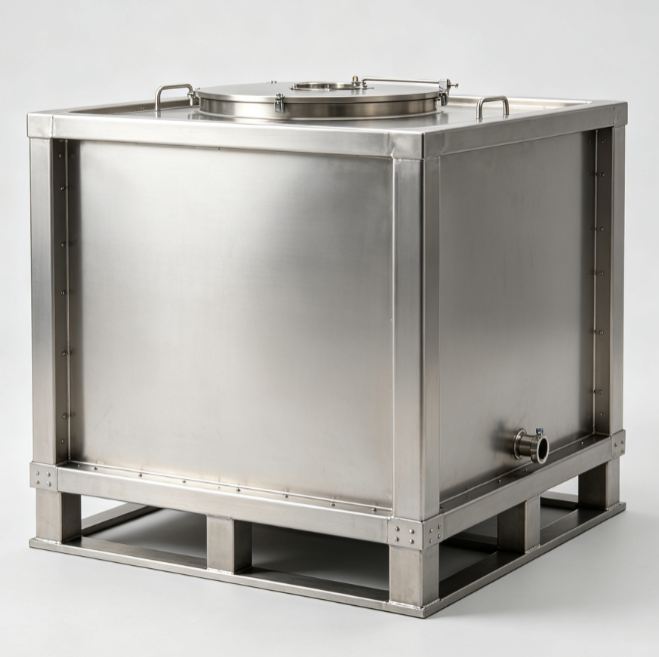
Table of Contents
Introduction
The Geometry of Efficiency – Why Square Beats Round
Space Utilization – The Numbers That Matter
Stacking and Modular Design – Vertical Capacity
Installation and Site Logistics – Practical Advantages
Structural and Material Considerations
Applications Across Industries
Conclusion
Frequently Asked Questions (FAQ)
1. Introduction
Floor space is expensive. In industrial facilities, warehouses, and commercial buildings, every square meter carries a cost. The choice of storage tank shape directly affects how much of that expensive space is actually used for storage—and how much is wasted as dead space between vessels.
The round tank has been the default choice for decades. It is structurally efficient, handles pressure well, and requires less material for a given volume. But it leaves gaps. Round tanks cannot sit flush against walls. Round tanks cannot sit flush against each other. The gaps between them add up to significant wasted floor space.
The square tank solves this problem. It fits against walls, sits flush with adjacent tanks, and uses every square meter of its footprint for storage. The geometry is simple—and the numbers are compelling.
2. The Geometry of Efficiency – Why Square Beats Round
The fundamental advantage of a square tank is its footprint. A round tank with a given diameter occupies a circular footprint. The area around it—the corners of the square that would contain the tank—is wasted space. A square tank of the same width fills that square completely.
The gap problem. When multiple round tanks are placed side by side, the gaps between them are unavoidable. The curved surfaces create dead space that cannot be used for storage, equipment, or access. Square tanks eliminate this problem. They can be placed directly against walls and closely aligned with one another, reducing unused gaps between vessels and increasing storage capacity within the same area.
The capacity comparison. The data is clear: by using a tank with a square footprint instead of a cylindrical tank, storage capacity can be increased by more than 20% while consuming the same floor space. Some manufacturers report even greater gains—up to 30% more storage capacity in the same footprint.
Tank Shape | Footprint | Gaps Between Tanks | Wall Placement |
Round | Circular | Significant dead space | Cannot sit flush |
Square | Rectangular | Minimal to none | Sits flush against walls |
3. Space Utilization – The Numbers That Matter
The space efficiency of square tanks translates directly into measurable gains.
20% more capacity in the same footprint. A square tank can store more than 20% additional volume compared to a cylindrical tank occupying the same floor area. For large indoor applications, this advantage is amplified by the ability to pass through standard doorways, which round tanks of equivalent capacity often cannot.
30% more water in the same area. Prismatic (square or rectangular) tanks are designed specifically to achieve maximum storage volume in narrow, low-ceilinged, or oddly shaped areas. In angular rooms where cylindrical tanks cause space loss, square tanks utilize the entire area efficiently, storing up to 30% more water in the same footprint.
15% less wasted space during transport. The square shape optimizes stacking and storage space, reducing wasted space by up to 15% compared to round tanks during transportation and storage. This is a significant logistics advantage for manufacturers and distributors.
Compact stacking in commercial settings. Square tanks enable compact stacking and optimal space utilization in diverse environments, making them ideal for compact commercial or industrial settings.
4. Stacking and Modular Design – Vertical Capacity
Square tanks offer stacking advantages that round tanks cannot match.
Stable stacking. Square and rectangular tanks are inherently easier to store and more stable when stacked upon each other. Their flat tops and bottoms provide even weight distribution, reducing the risk of shifting or tipping.
Three-high empty stacking. Sturdy square units with steel frames can be stacked three-high when empty, dramatically reducing the storage footprint during downtime or between uses.
Two-high filled stacking. Some square tanks, such as Western Global's TransCubes, can be stacked two high even when filled with fuel. This doubles the storage capacity of a given floor area without requiring additional footprint.
Modular expansion. Square tanks are often designed with modular construction, enabling easy expansion as storage needs grow. Sectional GRP (glass-reinforced plastic) tanks can be scaled up by adding panels, providing flexibility that round tanks do not offer.
5. Installation and Site Logistics – Practical Advantages
The practical advantages of square tanks extend beyond the storage room.
Doorway access. For indoor applications, square and rectangular tanks can pass through standard doorways that would block round tanks of equivalent capacity. This is a critical advantage for installations in basements, existing buildings, and retrofit projects.
On-site assembly. Modular square tanks can be assembled on-site, with parts brought through narrow entrances and welded in the final location. This eliminates the need for oversized delivery and crane access.
Reduced manifold connections. Square and rectangular tanks require fewer manifold connections than multiple round tanks providing the same total capacity. This simplifies plumbing, reduces potential leak points, and lowers installation costs.
Ease of plumbing and piping. The flat sides of square tanks allow for easier plumbing and piping design compared to the curved surfaces of round tanks. Fittings can be installed flush against flat walls, simplifying connections and maintenance.
6. Structural and Material Considerations
The structural trade-off of square tanks is well understood. Round tanks are structurally more efficient under internal pressure because they distribute hoop stresses evenly without stress concentrations at corners. Square tanks require additional reinforcement to handle the same pressures.
Reinforcement strategies. Modern square tanks address this through reinforced construction. Stainless steel prismatic tanks use internal tie rods (bands) to increase resistance to pressure, preventing deformation (bulging) when filled. The base sheet is thicker than the body to handle the higher pressure at the bottom.
Material options. Square tanks are available in a range of materials:
Stainless steel (AISI 304, 316) offers corrosion resistance, hygiene, and long service life.
Linear low-density polyethylene (LLDPE) with UV inhibitors provides excellent resistance to corrosion and harsh chemicals.
Glass-reinforced plastic (GRP) is modular, lightweight, and corrosion-resistant.
Structural innovations. Patent designs combine the higher volume of square footprints with the structural efficiency of cylindrical tanks. The "Recta-Cylinder" design uses alternating vertically-stacked cylinders and rectangular prisms, taking advantage of hoop strength while maintaining a square footprint.
7. Applications Across Industries
Square storage tanks are used across a wide range of industries.
Industry | Application | Key Benefit |
Wineries and breweries | Wine storage, blending, fermentation | Maximum floor space utilization, stackable design |
Chemical processing | Chemical storage, process liquids | Space efficiency, corrosion resistance, secondary containment |
Water treatment | Potable water, process water, stormwater | Maximum volume in tight spaces, modular expansion |
Food processing | Liquid ingredients, sanitation | Hygienic stainless steel, easy cleaning |
Fuel storage and distribution | Diesel, gasoline, fuel oil | Stackable filled tanks, reduced site footprint |
Offshore and marine | Chemicals, process fluids | Reduced height and footprint, safer stacking |
Agriculture | Water storage, liquid fertilizers | Space optimization, durability |
In wineries, square tanks fit tightly together with no wasted gaps, making them ideal for cellars and warehouses where floor space is limited. In chemical plants, square dual-containment tanks help meet secondary containment regulations while storing process liquids more efficiently. In fuel distribution, square cube tanks take up less space on site while holding the same capacity as round tanks.
8. Conclusion
Square storage tanks maximize floor space and increase storage capacity through simple geometry. They fit against walls. They sit flush with each other. They eliminate the dead space that round tanks leave behind.
The numbers are compelling: 20% more capacity in the same footprint, up to 30% more storage in the same area, and the ability to stack three-high when empty. For indoor applications, square tanks pass through standard doorways. For modular expansion, they scale with demand.
The structural challenges are solvable. Internal tie rods, thicker base sheets, and advanced designs like the Recta-Cylinder combine the space efficiency of square tanks with the structural integrity of cylinders. Materials like stainless steel, LLDPE, and GRP provide corrosion resistance, hygiene, and durability across industries.
For facility managers, engineers, and procurement professionals, the question is not whether square tanks save space—it is how much space they could be saving.
9. Frequently Asked Questions (FAQ)
Q: How much more capacity does a square tank provide compared to a round tank?
A: A square tank can provide more than 20% additional storage capacity in the same floor footprint. Some prismatic tank designs achieve up to 30% more storage in the same area.
Q: Can square tanks be stacked?
A: Yes. Square tanks can be stacked three-high when empty, and some designs can be stacked two-high even when filled. The flat tops and bottoms provide stable weight distribution.
Q: Are square tanks as durable as round tanks?
A: Round tanks are structurally more efficient under internal pressure because they distribute stress evenly without corners. However, square tanks address this through reinforcement—internal tie rods, thicker base sheets, and advanced designs that combine square footprints with cylindrical structural elements.
Q: What materials are square tanks available in?
A: Square tanks are available in stainless steel (AISI 304, 316), LLDPE with UV inhibitors, GRP (glass-reinforced plastic), and carbon steel.
Q: Where are square tanks most commonly used?
A: Square tanks are used in wineries and breweries, chemical processing, water treatment, food processing, fuel storage, offshore applications, and agriculture.
Q: Can square tanks be installed in existing buildings with narrow doorways?
A: Yes. Square tanks can often be assembled on-site, with parts brought through narrow entrances and welded in the final location. This eliminates the need for oversized delivery.
Q: What is the "Recta-Cylinder" design?
A: The Recta-Cylinder is a patent design that combines the higher volume of a square footprint with the structural efficiency of a cylinder. The tank walls are formed by alternating vertically-stacked cylinders and rectangular prisms.