High Shear Emulsifier Selection Guide: Tip Speed, Rotor-Stator Workhead and Batch vs In-Line
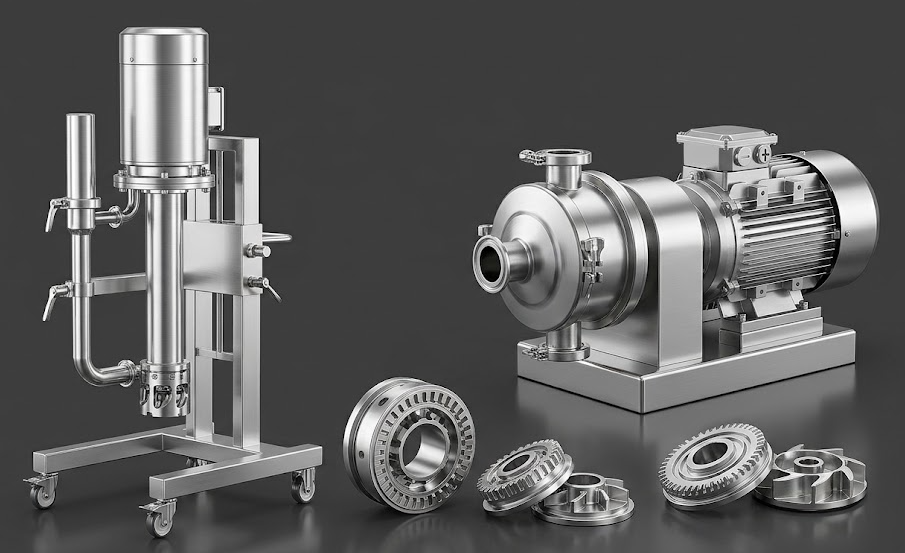
Table of Contents
What a High Shear Emulsifier Actually Does
Tip Speed and Droplet Size: the Core Selection Math
Batch or In-Line: Picking the Right Configuration
Viscosity, Batch Size and Motor Power
Stainless Steel, Surface Finish and Cleaning
Typical Specification Ranges Compared
What to Send With Your Enquiry
FAQ
What a High Shear Emulsifier Actually Does
A high shear emulsifier breaks one liquid phase into fine droplets and pushes them into another phase. The rotor spins fast inside a close-fitting stator. Product is drawn in, forced through the stator slots, and thrown out again at high velocity. So energy goes into the gap, not into bulk movement of the whole tank.
Three things usually happen at the same time. Droplets get cut down in size. Powder agglomerates get pulled apart. And the batch gets more uniform in composition and temperature. Each of those needs a slightly different setting, and that is why one machine rarely gives the best result for all three jobs.
This is also where a high shear emulsifier differ from a simple disperser with an open disc. The disperser is better for wetting pigment and pulling powder into liquid. Paint and ink labs check that stage with a grind gauge, following the method in ISO 1524:2020. Then the rotor-stator unit finishes the job when a fine, stable dispersion is needed.
Tip Speed and Droplet Size: the Core Selection Math
Tip speed is the single most useful number when you compare any high shear emulsifier. It is simple maths: tip speed = π × rotor diameter × rotational speed. Use metres and revolutions per second.
Take a rotor of 0.15 m running at 3,600 rpm. That is 60 revolutions per second, so the tip speed is π × 0.15 × 60, roughly 28 m/s. Double the rotor size and you get the same tip speed at half the speed, which usually is gentler on the motor and bearings.
In general mixing practice, rotor-stator heads often run somewhere in the 10–25 m/s band, and finer emulsions tend to sit at the upper end. No public standard fixes a magic value for every product. Above that range you often add heat faster than the jacket can remove it, and shear-sensitive formulations can suffer.
Droplet size is then verified by measurement, not by feeling. Laser diffraction is the common method, and ISO 13320:2020 describes the technique and states an applicable size range from about 0.1 µm up to 3 mm.
Passes Matter as Much as Speed
One pass through the workhead rarely gives the final result. In many plants the recipe says "three passes at X rpm", and that number comes from lab trials. Ask for a test with your own material before you sign for a machine, because water is not a good model for a viscous cream.
Batch or In-Line: Picking the Right Configuration
A batch unit hangs on the tank top or on a lift. It suits multi-product plants, because one machine can serve several vessels, or the machine can be lifted out for cleaning. Batch units also pair well with vacuum, which removes the air that gets folded in during powder addition.
An inline high shear emulsifier sits in a pipe loop. Every volume element sees the same shear history, which gives tighter batch-to-batch repeatability. It also handles the job of continuous feed into a downstream line, so there is no waiting for a tank to finish.
Many lines use both. An agitator does the bulk blending and powder wetting in the tank. Then an inline high shear emulsifier runs as a polishing step during transfer or recirculation.
Viscosity, Batch Size and Motor Power
Power demand climbs fast with speed. Under turbulent conditions the textbook relation is P = Np × ρ × N³ × D⁵, so doubling rotational speed can multiply power draw by around eight times. That is why the rotor diameter and speed have to be chosen together, and why the largest road is not always the fastest.
Viscosity changes everything too. A product that shear-thins can be pumped through an inline unit at high concentration, then comes back thick in the drum. A thixotropic paste may need a scraper agitator in the tank so fresher product keeps moving toward the workhead.
Talk through viscosity at process temperature, not at room temperature. Send values at both shear rates if you have them, since a single number from a Brookfield spindle hides a lot.
Stainless Steel, Surface Finish and Cleaning
Wetted parts are normally SS304 or SS316L. SS304 is common for general chemical, coating and food service. SS316L has the lower carbon content and better resistance to chlorides, so it is the usual pick for pharmaceutical work and for salty or acidic formulations.
Surface finish is usually discussed as a roughness value, and in hygienic service a smooth product contact surface is easier to clean and less likely to hold product. Specifications here depend on the actual process and the rules you answer to, so write the requirement into the order rather than assuming a default.
Cleaning method should be decided early. A unit that is specified as CIP and SIP cleanable needs the right seals, drain points and spray coverage. If you clean by hand instead, the design should allow quick teardown of the workhead.
Typical Specification Ranges Compared
The table below compares the two configurations of one high shear emulsifier family. Use it as a starting frame, not as a fixed offer.
Item | Batch rotor-stator head | Inline rotor-stator head |
Working capacity | 10 L – 5,000 L vessel | Continuous duty in a pipe loop |
Throughput | Set by batch cycle time | 0.5 – 50 m³/h |
Rotor speed | 0 – 3,600 rpm | 0 – 3,600 rpm |
Tip speed example | Approx. 28 m/s at 150 mm rotor and 3,600 rpm | Same maths applies |
Wetted material | SS304 / SS316L | SS304 / SS316L |
Contact material compliance | FDA-compliant materials | FDA-compliant materials |
Cleaning | CIP / SIP cleanable | CIP / SIP cleanable |
Certification stated | CE | CE |
Typical duty | Creams, resin emulsions, suspensions, small batches | Continuous lines, polishing pass after tank pre-mix |
Sources: equipment ranges above are the published figures of Jiangyin Zeshun Machinery, see https://www.zeshunequipment.com/products/emulsifier. Droplet size measurement method: ISO 13320:2020 Particle size analysis — Laser diffraction methods, https://www.iso.org/standard/69111.html. Grind assessment before emulsification: ISO 1524:2020 Paints, varnishes and printing inks — Determination of fineness of grind, https://www.iso.org/standard/76040.html.
What to Send With Your Enquiry
A short, clear data sheet saves weeks of e-mail. Put these items on one page:
l Batch size and target cycle time, including whether you want room for a future bigger batch.
l Viscosity at process temperature, plus behaviour during powder addition.
l Target droplet size, stated with the measurement method used in your lab.
l Whether the product is water-borne, solvent-borne, or both, since that drives the motor and sealing choice.
l Cleaning method and available utilities, including steam pressure if SIP is wanted.
l Preferred steel grade for wetted parts, and any surface finish requirement.
FAQ
Do I need a high shear emulsifier if I already have a good disperser?
They solve different steps. The disperser wets powder and pulls it into the liquid. The rotor-stator then grinds down what is left and stabilises the emulsion. Plants that only use a disperser often end up with a coarse tail that filtration later has to catch.
What tip speed should I ask for?
Start from your own target droplet size and work back with trials. Then ask the maker what rotor diameter and speed combination reaches that number on your material. Quote both figures in the order, not just the motor power.
Can one machine serve several tanks?
Yes. A batch unit on a lift, or a tank-mounted unit, can be moved between vessels. Vacuum and wall-scraping versions exist for larger vessels, and multi-tank layouts let one motor serve several stations.
Is SS304 enough, or do I need SS316L?
For general chemical, coating and food work, SS304 is the common choice. Move to SS316L where chlorides, aggressive cleaning agents or pharmaceutical documentation are involved. Your own process chemistry should decide it.
Can the machine run under vacuum?
Vacuum versions are used to take air out during powder addition and to stop foaming. They are worth considering whenever clarity matters or when the product is filled directly after mixing.