Automatic Powder Dosing System vs Powder Mixers: How to Choose for Lithium Battery and Pharmaceutical Lines
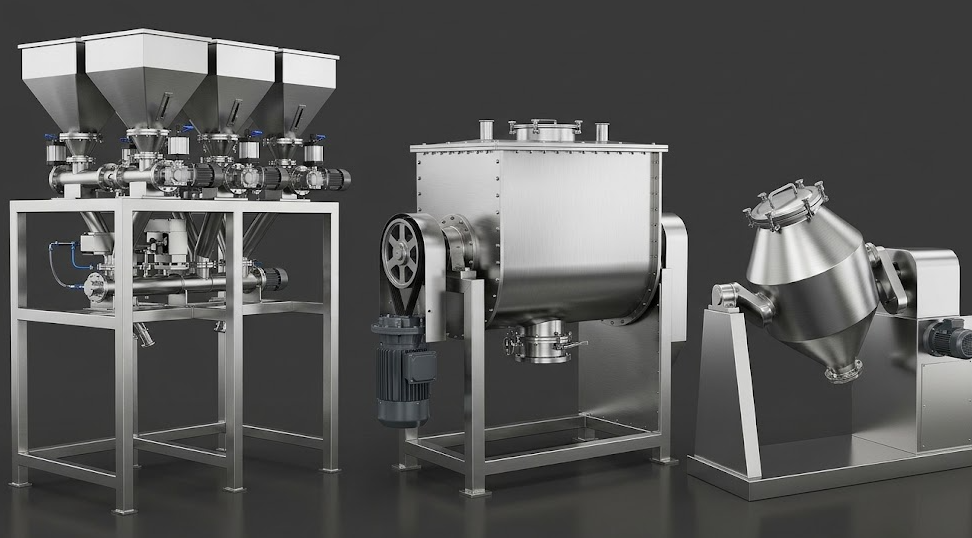
Table of Contents
Three Machines, Three Different Jobs
Where an Automatic Powder Dosing System Belongs
Horizontal Ribbon Blender vs 3D Rotary Drum Mixer
Accuracy, Throughput and Dust: the Numbers That Matter
Stainless Steel, Finish and Cross-Contamination Control
Combustible Dust and EU Conformity Basics
Side-by-Side Specification Comparison
Building a Complete Powder Line
FAQ
Three Machines, Three Different Jobs
Buyers often ask for "powder mixing equipment" when the real problem is weighing. And sometimes the reverse is true. These three machine types overlap in a plant, but they do not replace each other.
An automatic powder dosing system continuously weighs and feeds powder. A horizontal ribbon blender mixes powders, granules and pastes by moving them against each other with a ribbon agitator. A three-dimensional rotary drum mixer tumbles a closed drum so the material blends without any shaft inside.
So the first question is simple: do you need the right amount, or do you need the right blend? Most serious lines need both, and they buy them as one line rather than as separate items.
Where an Automatic Powder Dosing System Belongs
Weighing accuracy is the point of this machine. The published figures for the unit we build are ±0.1% weighing accuracy, a throughput range of 1–2,000 kg/h, SS304 or SS316L contact parts, IP65 dust protection, dust-free operation, automatic batch control and real-time monitoring.
Those numbers matter most in two places. In lithium battery slurry preparation, the electrode recipe decides coating quality, so a small powder error can turn into a whole tank of off-spec material. In pharmaceutical work, weighing is part of the batch record, and manual scooping leaves gaps in the record.
The automatic powder dosing system also takes the operator out of the dust cloud. That is a safety issue as much as a product quality issue, and it is discussed further below.
What It Does Not Do
A dosing machine does not blend well. It feeds. If you feed six ingredients accurately into a vessel and then mix badly, the result is still a bad mix. Accuracy and homogeneity are two separate targets, and each one needs its own machine.
Horizontal Ribbon Blender vs 3D Rotary Drum Mixer
The horizontal ribbon blender uses a double-helix ribbon. One helix pushes material one way, the other pushes the other way, so the batch moves in opposite directions at the same time. It handles powders, granules and also pastes, and it is designed for low residue at discharge.
The three-dimensional rotary drum mixer has no agitator at all. The drum itself moves on several axes, so material keeps changing position and there are no dead corners around a shaft or seal. That suits fragile granules that would break under a ribbon, and it suits small, high-value batches where clean-out between lots is critical.
In practice, the ribbon blender usually wins on throughput and on pastes. The 3D drum wins where gentle action and full discharge of a small batch are worth more than speed.
Accuracy, Throughput and Dust: the Numbers That Matter
Three numbers should be written into the specification before you talk to any maker:
l Weighing accuracy you actually need, stated as a tolerance on each ingredient and on the total batch.
l Throughput in kg/h at your real recipe, including the slowest ingredient, not the fastest one.
l Number of recipes and lots per shift, because cleaning time between lots often decides the real output.
A ±0.1% figure normally describes what the dosing hardware can do under stated conditions. Your automatic powder dosing system result also depends on hopper refill behaviour, how freely the powder flows, and how much bridging happens in the silo. Poor-flowing powders are the usual reason a good machine misses spec.
Throughput ranges are wide for a reason. A 1–2,000 kg/h span covers anything from a pilot line to a full electrode slurry plant. Do not size to the top of the range unless the line will actually run there, because oversizing a dosing unit hurts accuracy at the low end.
Stainless Steel, Finish and Cross-Contamination Control
Contact parts are usually SS304 or SS316L. SS316L is the common request in pharmaceutical and fine chemical service, and SS304 is widely used for food and general chemical powders.
Finish matters for flow as much as for cleaning. Smoother contact surfaces tend to release powder better and clean faster. Surface requirements should be written into the order, since default finishes vary between builders.
Then think about how material arrives and leaves. Enclosed transfer through a mobile conical silo, a square silo with discharge valve, or a frame-type IBC bin keeps the powder contained between steps. Open handling between units undoes the dust control you paid for.
Combustible Dust and EU Conformity Basics
Fine powders are not inert. The U.S. Occupational Safety and Health Administration notes that any combustible material can burn rapidly in finely divided form, and that the U.S. Chemical Safety and Hazard Investigation Board identified 281 combustible dust incidents between 1980 and 2005, with 119 workers killed and 718 injured. Pharmaceutical materials and dyes appear in its list of explosible dusts.
In the European Union, equipment intended for use in potentially explosive atmospheres falls under ATEX Directive 2014/34/EU, which applies from 20 April 2016 and replaced the earlier 94/9/EC. Machine safety in general rests on Machinery Directive 2006/42/EC today, and the newer Machinery Regulation (EU) 2023/1230, adopted on 14 June 2023, applies on a mandatory basis from 20 January 2027.
What this means on the shop floor is simple. Ask for the zone classification of the room, then ask the maker to match the motor, controls, earthing and enclosure design to it. Enclosed dosing with dust collection is the usual way to lower the risk rather than to manage it later.
Side-by-Side Specification Comparison
The comparison below uses published figures of our own machines plus general practice noted above.
Item | Automatic Powder Dosing System | Horizontal Ribbon Blender | 3D Rotary Drum Mixer |
Main job | Weighing and feeding by recipe | Convective blending of powders, granules and pastes | Gentle tumbling of dry powders and granules |
Published key figure | Accuracy ±0.1%, throughput 1–2,000 kg/h | Double-helix ribbon, low discharge residue | Multi-directional motion, no dead corners |
Contact material | SS304 / SS316L | SS304 / SS316L | SS304 / SS316L |
Dust control | Dust-free operation, IP65 protection | Enclosed trough with lid | Closed drum |
Control | Automatic batch control with real-time monitoring | Manual or automated start and discharge | Batch cycle control |
Suits pastes | No | Yes | No, dry materials only |
Typical application | Lithium battery powder dosing, pharmaceutical weighing | Food blends, chemical compounds, larger batches | Fragile granules, high-value small lots |
Upstream feed | Mobile conical silo, square silo with valve, IBC bin | Manual charge or screw feed | Manual or IBC charge |
Sources: equipment figures are the published specifications of Jiangyin Zeshun Machinery, see https://www.zeshunequipment.com/products/powder-dosing-system, https://www.zeshunequipment.com/products/horizontal-ribbon-blender and https://www.zeshunequipment.com/products/three-dimensional-rotary-drum-mixer. Dust hazard statistics: OSHA, Combustible Dust: An Explosion Hazard, https://www.osha.gov/combustible-dust. EU framework: European Commission, Equipment for potentially explosive atmospheres (ATEX), https://single-market-economy.ec.europa.eu/sectors/mechanical-engineering/atex_en, and European Commission, Machinery, https://single-market-economy.ec.europa.eu/sectors/mechanical-engineering/machinery_en.
Building a Complete Powder Line
A working line usually looks like this. Storage holds the raw powder in a silo, IBC bin or sealed tank. The automatic powder dosing system weighs out each ingredient into the mixing step. The ribbon blender or 3D mixer then blends to target homogeneity. From there material goes into a holding tank, and then to coating, filling or packaging.
Integration is where schedules slip, not machine building. An automatic powder dosing system only performs as well as the feed, discharge and controls around it, so those interfaces deserve attention early. Powder lines need coordinated controls, matched interfaces, and a layout that allows cleaning access and operator movement. Agreeing on this at design stage costs far less than fixing it during commissioning.
FAQ
Do I need a dosing system if I already have a blender?
If the weighing happens manually today, yes, most likely. Blenders mix but do not weigh. An automatic powder dosing system removes the manual step and gives a record of what went into every batch.
Which is better for lithium battery powder, ribbon blender or 3D mixer?
It depends on the material sensitivity and batch size. Ribbon blenders move material faster and handle pastes. The 3D rotary drum mixer treats fragile granules gently and empties fully. Many plants test both before deciding.
Will ±0.1% accuracy hold on every powder?
It describes dosing hardware capability under stated conditions. Actual results also depend on flow behaviour, bridging in the hopper and refill stability. Tell us the powder properties and we will check it before quoting.
How do I handle dust safely?
Start with the room classification, then choose enclosed transfer, dust collection and correctly rated motors and controls. The OSHA data above shows why open handling is a poor compromise.
Can the same line handle several recipes?
Yes. Automatic batch control with real-time monitoring supports multiple recipes. The important part is planning the cleaning step between lots, since that usually sets real throughput.
Do you supply stainless steel tanks too?
Yes. We build stainless steel storage tanks, silos, IBC bins and process vessels, plus agitation and dispersing units, so the powder line and the liquid side can come from one supplier.