Stainless Steel Reactor Selection Guide: Corrosion Resistance Comparison of 304 vs 316 Material for Chemical and Pharmaceutical Industries
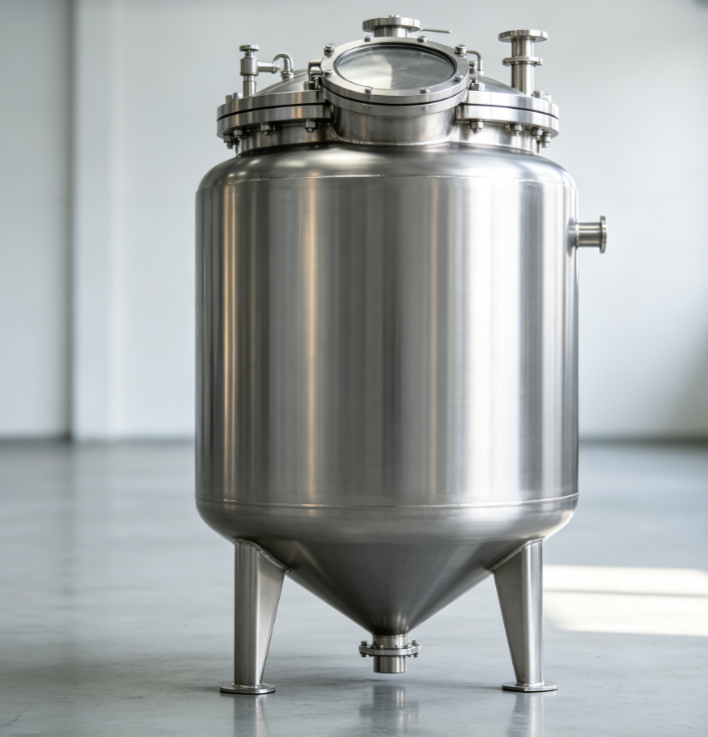
Table of Contents
1. Introduction to Stainless Steel Reactors for Industrial Applications
2. Basic Characteristics of 304 and 316 Stainless Steel Reactors
3. Corrosion Resistance Comparison in Typical Working Conditions
4. Application Differences Between Chemical Reactors and Pharmaceutical Reactors
5. Comprehensive Performance & Service Life Data Comparison
6. Key Selection Principles for Industrial Stainless Steel Reactors
7. Professional Industry FAQ
1. Introduction to Stainless Steel Reactors for Industrial Applications
Stainless steel reactors are core pressure vessels widely used in chemical and pharmaceutical production lines.
Different from carbon steel reactors, stainless steel models feature anti-rust, anti-corrosion and easy-clean properties.
Most industrial manufacturers choose 304 reactors or 316 reactors as mainstream configuration solutions.
Improper material selection often leads to tank body corrosion, medium leakage and shortened equipment lifespan.
According to 2025 chemical equipment industry statistics, over 62% of production failures are caused by mismatched reactor materials.
A professional corrosion resistance comparison is essential for long-term stable industrial operation.
2. Basic Characteristics of 304 and 316 Stainless Steel Reactors
2.1 304 Stainless Steel Reactor Features
304 stainless steel is the most common material for standard stainless steel reactors.
It contains standard chromium and nickel components, providing basic atmospheric and weak acid corrosion resistance.
This material has stable mechanical performance and cost advantages for general industrial scenarios.
It is widely applied in low-corrosive chemical mixing and ordinary synthetic reaction processes.
2.2 316 Stainless Steel Reactor Features
316 reactors add molybdenum element on the basis of 304 stainless steel components.
Molybdenum element greatly improves tolerance against chloride and strong corrosive media.
It owns better high-temperature stability and oxidation resistance than 304 material.
This grade is the preferred material for high-standard pharmaceutical reactors and fine chemical processing.
3. Corrosion Resistance Comparison in Typical Working Conditions
The core difference between the two materials lies in environmental adaptability and corrosion tolerance.
304 stainless steel performs well in pure water, weak alkali and weak acid environments.
But it is prone to pitting corrosion in chloride-containing and high-salt media.
316 material effectively resists salt corrosion, chlorine ion erosion and organic solvent corrosion.
It can maintain stable tank integrity under long-term high-temperature and high-corrosion working conditions.
4. Application Differences Between Chemical Reactors and Pharmaceutical Reactors
Chemical reactors face diverse and complex corrosive medium environments.
Ordinary chemical synthesis with low corrosion can fully adopt 304 stainless steel reactors.
Fine chemical, salt-containing and acidic reaction scenarios must use 316 reactors.
Pharmaceutical reactors have stricter hygiene and anti-pollution standards.
316 stainless steel features better polishing performance and no residual medium adhesion.
It meets GMP purification production requirements for pharmaceutical raw material synthesis.
5. Comprehensive Performance & Service Life Data Comparison
The table below shows verified working performance data of 304 and 316 stainless steel reactors, based on ASME BPVC industrial pressure vessel standards.
Performance Item | 304 Stainless Steel Reactor | 316 Stainless Steel Reactor | Performance Advantage |
Chloride Corrosion Resistance | Weak, Prone to Pitting | Excellent, Long-Term Stable | 316 Stronger |
Weak Acid & Alkali Tolerance | Good | Excellent | 316 Slightly Better |
Average Service Life (Industrial Use) | 6–8 Years | 10–15 Years | 316 +60% Lifespan |
Pharmaceutical GMP Adaptability | General | Fully Compliant | 316 Professional Grade |
The data proves that 304 reactors are cost-effective for general scenarios, while 316 reactors dominate high-corrosion and high-purity production environments.
6. Key Selection Principles for Industrial Stainless Steel Reactors
Users should select stainless steel reactors according to actual production medium characteristics.
For water-based, weak corrosive and general chemical reactions, 304 material is the most economical choice.
For chloride, strong acid, high-purity pharmaceutical processing, 316 stainless steel is mandatory.
Reasonable material matching avoids frequent equipment maintenance and production shutdown losses.
7. Professional Industry FAQ
Q1: What is the biggest difference between 304 reactor and 316 reactor?
A1: The core difference is molybdenum element. 316 material adds molybdenum, which greatly improves chloride and strong corrosion resistance compared with 304 stainless steel.
Q2: Can 304 stainless steel reactors be used for pharmaceutical production?
A2: It only applies to low-purity and non-corrosive pharmaceutical auxiliary processes. Formal GMP pharmaceutical production requires standard 316 pharmaceutical reactors.
Q3: Which material is more suitable for fine chemical corrosive reaction?
A3: 316 stainless steel reactor is the best choice, as it resists organic solvent and salt corrosion effectively and ensures long-term stable operation.
Q4: Is 316 reactor worth the higher investment cost?
A4: Yes. Although the initial cost is higher, its service life is much longer than 304, and it reduces replacement and maintenance costs in corrosive working conditions.